The Gulf Oil Spill: Will it Destroy Your Boat?
Beyond the terrible environmental impact, Gulf boaters have a more personal concern: what effect the oil spill will have on their fiberglass, dacron, and teak.
May 5, 2010
For boaters throughout the Gulf States, the oil spill currently underway makes them sad, angry, and upset, like millions of other Americans. But they all have another common concern: “Is the oil leak from the former Deepwater Horizon platform going to ruin our boats?”
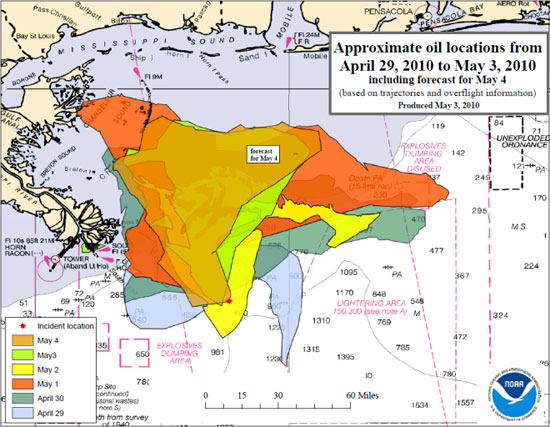
Approximate locations of oil with different dates (April 29-May 4) shown as different colors.
I spoke yesterday morning with Stanton Murray, head of Murray Yacht Sales with offices around the Gulf, and he described to me a litany of fears that boat owners are raising about operating their boats in oily waters. Fortunately, the short answer to their question is, “No, it won’t.” But, since this is a topic that will be at the head of waterfront conversations for some time to come, more than a short answer is in order.
One of the keys to this whole question has to do with the viscosity or thickness of the oil you are likely to be running your boat through. It is true that the basic product leaking from the underwater pipes is the approximate consistency of roofing tar, one thick, gooey substance. But that’s pretty much where it ends. The clean-up crews have been employing a variety of strategies to contain or disperse this mess, and the results of these techniques are important knowledge when analyzing the actual impact to recreational or commercial boats.
Let’s talk about the burn-off approach first. Crews have been actively burning off some of the surface oil. What this does is leave behind a residual that resembles a clump of tar, similar to paving asphalt. Then, crews can net or skim these tar balls for removal. What they miss will sink to the bottom of the Gulf.
We’ve been hearing a lot about the use of chemical dispersants being sprayed into patches of the surface-riding oil. This too sinks the oil to the bottom. So, what’s left is essentially nothing more than a surface sheen on the water. It smells bad, looks bad, and yes it is oily to the touch, but will it kill your boat’s systems? If it splashes on your teak deck or sails and upholstery is it the end? What about your boat’s raw water intakes for such things as engine cooling or your air conditioning system? Let me walk you through each aspect of this problem.
Dacron Sails
Suppose your sails get splashed with this oil-contaminated water. What are you doing to do? Mild soap and water and a soft scrub brush will clean it. I’ve used Ivory dishwashing liquid for this purpose many times. Scrub in line with any seams and rinse thoroughly with warm water. Let it dry. Make sure not to use any solvents on sails as it may attack the resins in the Dacron, and could damage Mylar or Kevlar. Soap and water only, please.
Fiberglass Hulls and Decks
MDR’s Krazy Clean will do a great job of washing these as well as any vinyl surfaces. The oil will not damage the fiberglass in any way. If you were to get one of the tar balls on board and somebody stepped on it, there are a variety of tar removers available; use one of those or even a rag with some acetone and it will wipe right up.
Unsealed Teak Decks and Rails
Te-Ka, Star Brite teak cleaner, Oxalic acid, or any other commercially available cleaners used for wood surfaces will get the stains out. Then re-treat to personal taste by either re-oiling or sealing. Again, no permanent damage has been done.
Raw Water Intakes
OK, this one is a little tougher. Since all of these systems are drawing sea water into your boat near the surface, the thick gooey globules of oil are extremely unlikely to get sucked into your boat’s systems. If they did, yes, it would gum things up for sure, but since the heavy oil is sinking to well below the surface in this case, the remaining sheen is so diluted that it will not cause any permanent damage to your boat. I’ve been asked about the long-term effect on things like water-pump impellers, heat exchangers and such. All of the impeller products I’m familiar with are made of Neoprene and in fact are quite resistant to damage by exposure to oil. Marine grade hoses are also made of oil resistant materials. As for the plastic and metal parts used in these systems, the oil will have no influence on them. If you motor or sail your boat through an area with oil sheen on the surface, no harm will be done to your boat. These systems will clean themselves out as they continue to pump through relatively clean water.
Anchor Rode and Running Rigging
Virtually all of these “ropes” are made of synthetic materials today. I take mine and wash them in the Ivory dishwashing and warm-water solution every year. It’ll clean them nicely without any damage. Just be sure to rinse them out well and hang to dry before stuffing them in a sealed space.
In Conclusion
So, would I sail through the epicenter of the leak looking for giant oil globules? No, in a word. But would I take my boat out and use it intelligently to get from point A to B? Sure, just like the boats that are out there in the Gulf right now working diligently to contain this mess; are they doomed? Of course not.
Messy, you bet! Evironmental impact, for sure! Smell funny, absolutely! But will the spill kill your boat? No way, it’ll just give you an excuse to do a really thorough clean up job.
Editor's Note: For more, read the author's blog about the upcoming race across the Gulf, Regata al Sol XXVI.